QR Cake vs ME-QR: Free QR Code Generators Compared
ME-QR is free but ad-supported. QR Cake's free codes stay useful, and paid plans remove ads. Here's the honest comparison on features, longevity, privacy, and which fits your use case.
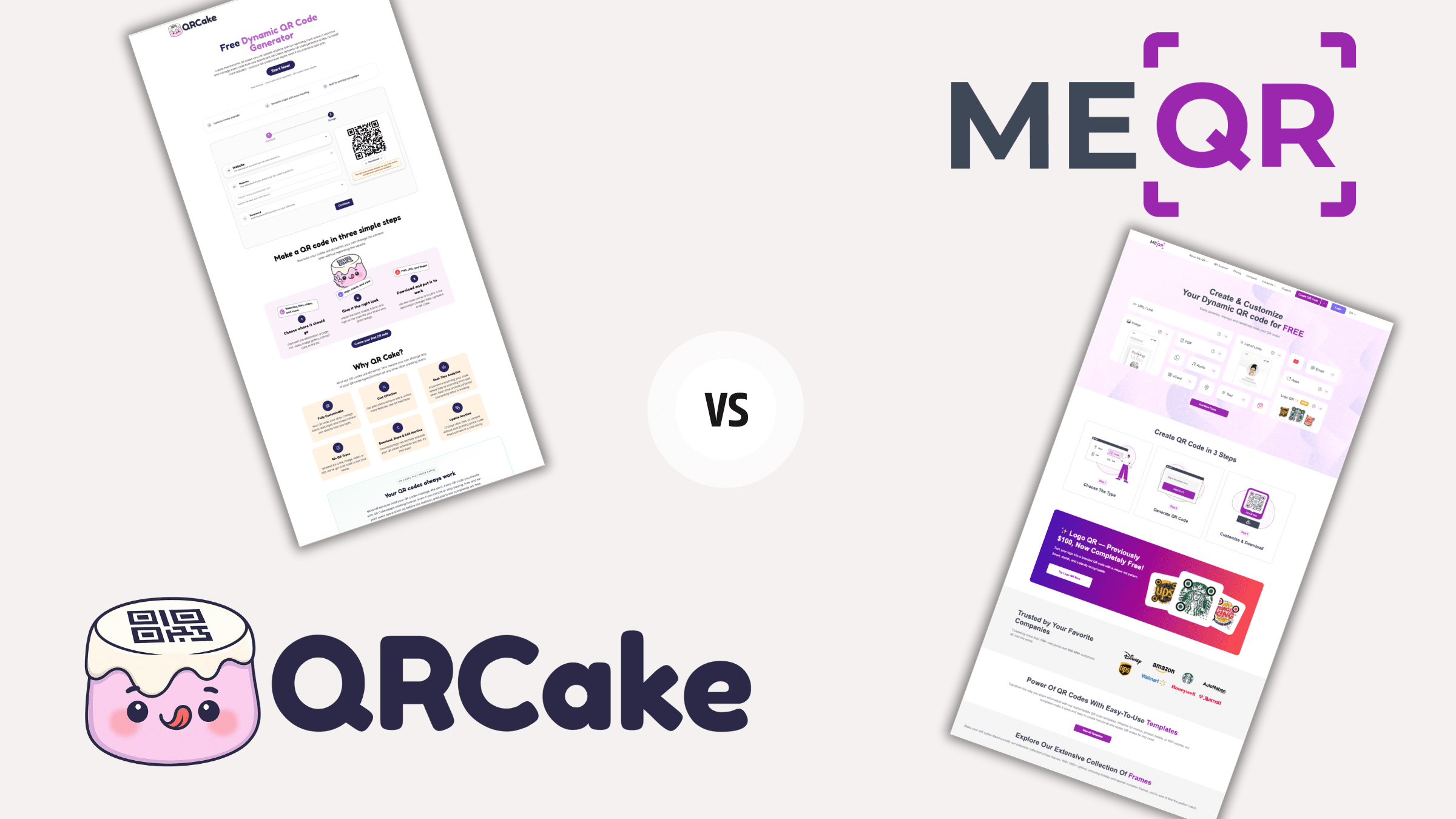
QR Cake is the smaller alternative built around clearer trade-offs. We also offer free dynamic QR codes, free scans may show a short ad before redirecting, paid plans remove ads, and we have an official Canva app integration.
These are two genuinely free dynamic QR generators with different business models. This post lays out the differences from the QR Cake team - including a section on where ME-QR is the better fit.
TL;DR
| Criterion | QR Cake | ME-QR |
|---|---|---|
| Free dynamic codes | Included | Included |
| Ads in dashboard / landing pages | Free scans may show a short redirect ad; paid plans remove ads | Included |
| Codes survive cancellation | Included | n/a (free model) |
| Number of languages supported | English-first | Multiple languages |
| Code types | Common + Canva | Wide range |
| Canva integration | Included (official app) | Not included |
| Professional / business appearance | Clean | Ad-supported feel |
| Pricing transparency | Public | Public |
| Best for | Business use, Canva users | Personal use, hobby projects, multi-language |
Pick QR Cake if you're using QR codes for business and want a paid plan that removes ads from the scan experience.
Pick ME-QR if you want maximum free features for personal or hobby use and don't mind ads, or if you need extensive multi-language support.
Where ME-QR genuinely wins
Honest first:
Genuinely free at high volume. ME-QR's free tier supports a lot of dynamic codes without pushing you to upgrade. If you're an individual creating dozens of QR codes for personal projects, ME-QR's free tier is unusually generous.
Multi-language support. ME-QR has invested in localisation across many languages. If you're a non-English speaker, especially in Eastern European or Asian markets, their interface and help docs may be available in your language while QR Cake is currently English-first.
Wide range of code types. ME-QR offers many code types (PDF, image, video, vCard, social, app store, file, URL, etc.), comparable to the larger paid platforms. For a free tool, this breadth is notable.
Established at scale. ME-QR has been around for years and serves a huge user base. The infrastructure has been battle-tested under high load. For a free tool, that operational maturity is reassuring.
No subscription anxiety. Because the business model is ad-supported rather than subscription-based, there's no risk of "my codes stopped working because I forgot to renew." Your codes keep working as long as ME-QR operates the service.
Where QR Cake wins
Clear ad trade-off. This is the single biggest difference. ME-QR serves ads in the dashboard, and depending on configuration, may serve ads on the landing pages your QR codes redirect to. QR Cake is upfront: free dynamic scans may show a short ad before redirecting, and paid plans remove ads from the scan experience.
Professional appearance. Beyond ads, the overall feel of ME-QR is "free internet tool" - interstitials, language-switching headers, occasional upsell modals. QR Cake's interface is closer to a typical SaaS product. For business users, this matters.
Canva integration. QR Cake has an official Canva app that embeds live dynamic codes inside Canva designs. ME-QR doesn't have an equivalent integration. For marketing teams that build everything in Canva, this is a real workflow advantage.
Cleaner short URLs. QR Cake's short URLs are cleanly branded. ME-QR's are functional but less polished. For codes printed on customer-facing assets, the short URL appearance matters more than people expect.
Stronger privacy posture. The exact data-collection practices of ad-supported free tools are often harder to verify than those of subscription-based products. QR Cake's business model is transparent: free dynamic scans may show a short ad, paid plans remove ads, and we don't sell scan data. ME-QR's privacy practices may be fine, but ad-supported services intrinsically have more complex data relationships.
Faster scan-to-destination. Some ad-supported QR redirects include an interstitial or delay before redirecting. QR Cake's paid redirects are direct and ad-free; free scans may show a short ad before redirecting. For high-conversion contexts (a restaurant menu, a flash sale code), milliseconds matter.
Feature-by-feature comparison
| Feature | QR Cake | ME-QR |
|---|---|---|
| URL codes | Included | Included |
| vCard codes | Included | Included |
| PDF / file hosting | Included | Included |
| Video codes | Included | Included |
| WiFi codes | Included | Included |
| App Store routing | Included | Included |
| Social multi-link | Included | Included |
| Image / gallery codes | Included | Included |
| Customisation: colours | Included | Included |
| Customisation: logo | Included | Included |
| Frames and CTAs | Included | Included |
| Analytics: scans, geo, device | Paid (Pro and Business) | Included |
| Multi-language interface | English-first | Many languages |
| Custom domain | Paid | Paid |
| API access | Included | Paid |
| Ads in dashboard | Not included | Included |
| Ads in scan flow / landing pages | Free scans may show a short redirect ad; paid plans remove ads | Sometimes |
| Canva integration | Included | Not included |
| Codes survive long-term without paying | Included | Included |
For core dynamic QR functionality, both products offer roughly equivalent features. The differences are in business model (ad-supported vs transparent free-and-paid trade-off), Canva integration (QR Cake wins), and professional polish (QR Cake wins).
The "free" question: which is really free?
Both are genuinely free for dynamic codes. The trade-off is different:
ME-QR's "free" means: you don't pay money, you don't lose codes if you stop using the dashboard, but you do see ads, and your end users may see ads on landing pages. The cost is attention and brand perception.
QR Cake's "free" means: you don't pay money and your codes keep working, but free scans may show a short ad before redirecting. Paid plans remove ads and unlock more room for growing campaigns.
For personal use, ME-QR's trade-off is acceptable for most people. For business use, the ads on customer-facing landing pages are usually a dealbreaker - which is why most businesses that try ME-QR eventually switch to a clean subscription-based platform.
Privacy and data: a quick honest look
This is the section most QR comparison articles skip.
Ad-supported free services monetise by serving ads, which typically requires sharing some information with ad networks. The specific information varies by provider and configuration. For low-stakes personal use, this is normal internet behaviour. For business use involving customer data, it deserves more scrutiny.
Subscription-based services (including QR Cake) monetise by selling plans. There's no ad-network relationship, which means a simpler data flow. Scan data is collected for analytics, but it stays with the platform.
Neither model is intrinsically "bad." For business use, the simpler data flow of subscription services is usually preferred. For personal use, the ad-supported model is often acceptable.
If you're handling any sensitive use case (healthcare, finance, customer PII), neither ME-QR nor QR Cake's free tier is the right tool - you want a compliance-certified platform like Uniqode.
Decision frame
Quick way to pick:
- Is this for business or customer-facing use? If yes, lean QR Cake on a paid plan so ads are removed from customer-facing scans.
- Will your end users land on the QR code's destination page? If yes and you can't guarantee the landing page is yours, lean QR Cake.
- Do you need multi-language interface support? If yes, ME-QR has wider language coverage.
- Is this for personal or hobby use where ads don't matter? If yes, ME-QR's generous free tier is fine.
- Do you build in Canva? If yes, lean QR Cake.
- Do you need API access on the free tier? Both offer APIs, but QR Cake's is available on more accessible plans.
The practical split: QR Cake for business and Canva users, ME-QR for personal use and multi-language markets.
Use case examples
Use ME-QR for:
- A student creating QR codes for a school project.
- A non-English-speaking user where ME-QR is localised in their language.
- A personal blog or portfolio QR code where ads aren't a concern.
- A hobby project where you want lots of free codes and don't care about the ad experience.
Use QR Cake for:
- A small business putting QR codes on menus, packaging, or business cards.
- A marketing team running campaigns where customer perception matters.
- An agency creating QR codes for client work.
- Anyone building in Canva who needs live QR embedding.
- A freelancer who wants a professional-looking dynamic code for their portfolio.
Migration: switching between the two
Standard QR migration constraints apply. The QR code itself encodes a URL pointing at the original provider's servers, so switching means generating new codes.
If you've used a custom domain (e.g., qr.yourbrand.com) on either platform, you can move the DNS to the other platform without changing the printed codes. This is the single best reason to invest in a custom domain - it gives you the freedom to switch later.
Switching from ME-QR to QR Cake is a common path: users start with ME-QR's free tier for personal use, then upgrade their needs to business use, hit the ad limitation, and move to a platform where paid plans remove ads clearly. If you're at that point, set up the new codes, switch your printed materials when you next reprint, and let the old codes coexist for a transition period.
Frequently asked questions
Is ME-QR really free? Yes - the free tier supports dynamic codes without payment. The trade-off is ads in the dashboard and sometimes on the landing pages. Paid plans on ME-QR remove ads and add features.
Does ME-QR put ads on the landing pages my QR code points to? Sometimes, depending on the type of code and the user's plan. For URL codes pointing at an external website, the ad-serving is usually limited to the redirect interstitial or absent. For codes using ME-QR's built-in landing pages, ads may be present. Read the current terms before using ME-QR for business-critical assets.
Are ME-QR's codes safe to scan? Yes, the codes themselves are safe. The question is whether the destination experience is appropriate for your audience. For personal use, fine. For business use, the ad-supported model usually isn't.
Can I remove ads on ME-QR without paying? No. The ad-supported model is the free tier's funding mechanism. Paid plans remove ads.
Does QR Cake have ads on its free tier? Free dynamic scans may show a short ad before redirecting. Paid plans remove ads from the scan flow; the free tier stays useful for creating and testing dynamic codes.
Which has better analytics? Roughly equivalent for the core metrics, but QR Cake includes them only on the Pro and Business plans, not on the free tier. Advanced analytics (real-time, integrations) sit behind paid plans on both platforms.
Will ME-QR's codes work if I stop using the platform? Likely yes, as long as ME-QR continues operating the service. The codes don't depend on a subscription, just on ME-QR's infrastructure remaining live.
Will QR Cake's codes work if I stop using the platform? Yes. Codes continue resolving to their last-saved destination indefinitely. You lose editing and analytics access; the redirect keeps working.
Which has more languages? ME-QR. Their interface and help docs are localised across many more languages than QR Cake's. If language coverage is critical, ME-QR has a real advantage.
Can I use ME-QR for my restaurant menu? Technically yes. Practically, the ad-supported feel doesn't fit a customer-facing restaurant experience. Most restaurants that try this end up switching to a clean platform within a few weeks.
Bottom line
ME-QR is genuinely useful for personal use, hobby projects, and multi-language markets. The ad-supported model makes high-volume free use practical in a way that subscription-based products can't match.
QR Cake is the better fit for business use, customer-facing assets, marketing campaigns, and anyone who builds in Canva. Paid plans remove ads from the scan experience when the QR code is part of a professional context.
Try QR Cake's free dynamic QR codes
Ready to make your own QR code?
Create a dynamic QR code you can edit after printing. Free to start, no card required, unlimited scans, and your codes never expire.

About the QR Cake team
Written by the QR Cake team - the people building QR Cake, a dynamic QR code platform used for editable print campaigns, Canva QR codes, scan analytics, and long-lived QR redirects that keep working after subscriptions end.
Learn more about QR CakeFrequently asked questions
- Is ME-QR really free?
- Yes. The free tier supports dynamic codes without payment. The trade-off is ads in the dashboard and sometimes on landing pages. Paid plans remove ads.
- Does ME-QR put ads on the landing pages my QR points to?
- Sometimes, depending on code type and plan. For external URL codes, ad-serving is usually limited or absent. For codes using ME-QR's built-in landing pages, ads may be present.
- Are ME-QR's codes safe to scan?
- Yes, the codes themselves are safe. The question is whether the destination experience is appropriate for your audience - fine for personal use, less ideal for business use.
- Does QR Cake show ads on free dynamic scans?
- Free dynamic scans may show a short ad before redirecting. Paid plans remove ads from the scan flow, and free codes remain useful for creating and testing dynamic campaigns.
- Which has more language support?
- ME-QR. Their interface and help docs are localised across many more languages than QR Cake's. If language coverage is critical, ME-QR has a real advantage.
- Can I use ME-QR for a restaurant menu?
- Technically yes, practically the ad-supported feel doesn't fit a customer-facing restaurant experience. Most restaurants that try this end up switching to a clean platform.
Related Articles
Keep reading practical QR code guides, examples, and optimization tips.
QR Cake vs QR Tiger: Honest Comparison for Dynamic QR Code Users
QR Tiger and QR Cake compete on roughly the same buyer. The differences cluster around customisation depth, Canva integration, and what happens when you stop paying.
QR Cake vs Uniqode: Which QR Code Platform Wins for Your Business?
Uniqode is the enterprise leader in dynamic QR codes. QR Cake is the smaller, more focused alternative with a free tier and an official Canva app. Here's an honest head-to-head from the QR Cake team.
Best QR Code Generators Compared (2026): An Honest Side-by-Side
Most 'best of' articles are either thinly disguised affiliate pages or marketing pieces from one of the brands. We tested seven of the biggest ones across the dimensions that actually matter for business use.