QR Cake vs QR Tiger: Honest Comparison for Dynamic QR Code Users
QR Tiger is a strong freemium QR platform. QR Cake offers free dynamic codes that don't expire. Here's exactly how they compare on features, pricing, and longevity.
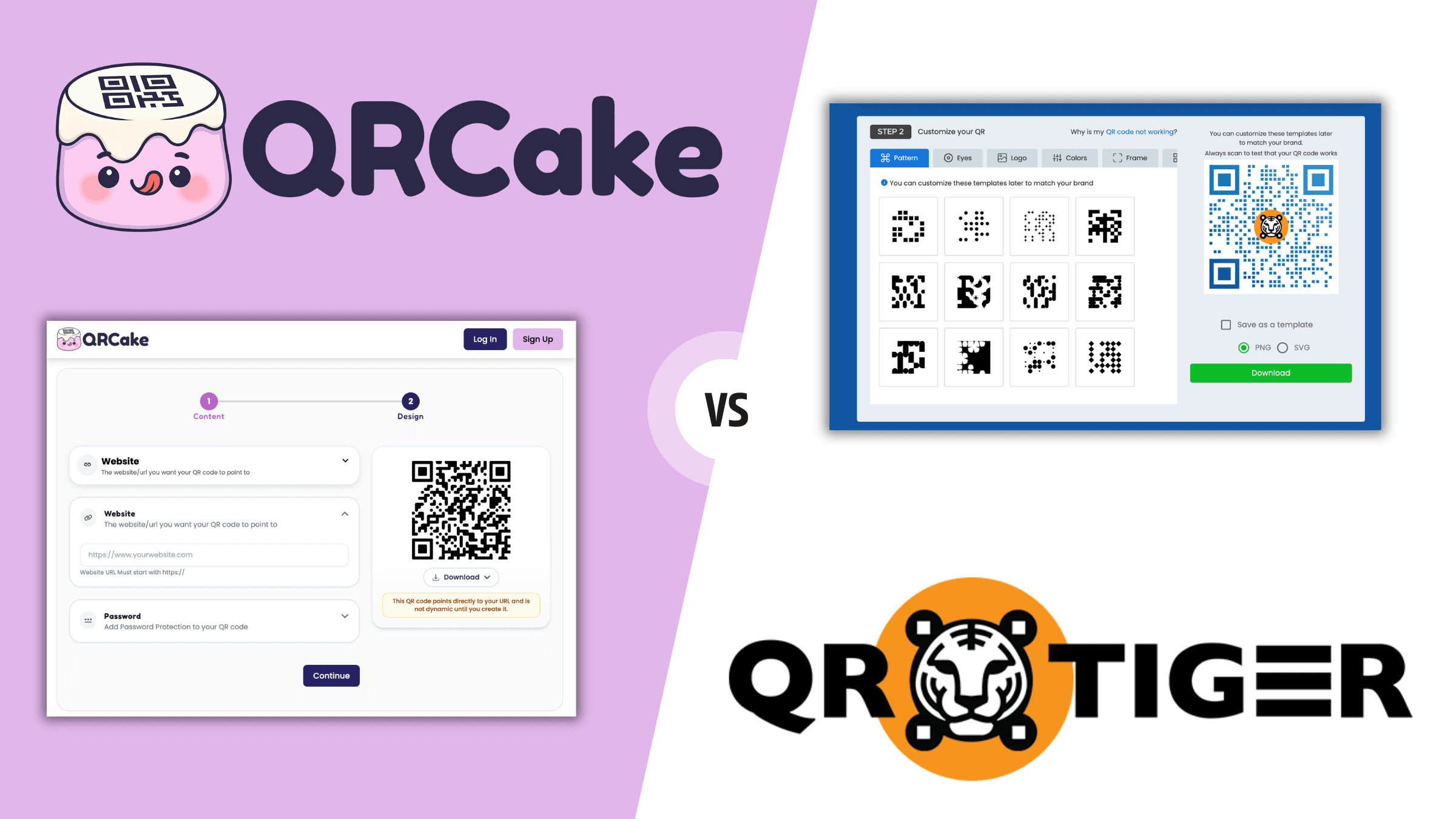
QR Cake is the newer, more focused alternative. We compete primarily on three things: a genuinely free dynamic tier, codes that don't break when you stop paying, and an official Canva integration.
This is a head-to-head comparison from the QR Cake team. We'll be specific about where QR Tiger is the better fit, because for some use cases it genuinely is.
TL;DR
| Criterion | QR Cake | QR Tiger |
|---|---|---|
| Free dynamic codes | Included (real free tier) | Limited free trial |
| Codes survive cancellation | Included | Not included |
| Customisation depth | Good | Excellent |
| Bulk code generation | Paid | Included |
| Canva integration | Included (official app) | Not included |
| Analytics quality | Strong | Strong |
| Pricing transparency | Public | Public |
| Best for | Small business, simplicity, longevity | Mid-volume users, design-heavy QR campaigns |
Pick QR Cake if you want free dynamic codes that don't break and you live in Canva.
Pick QR Tiger if you want maximum customisation, you regularly create bulk codes, and you have a budget for a paid plan.
Where QR Tiger genuinely wins
Being honest about the competition:
Customisation is QR Tiger's strongest suit. They give you more eye-shape options, more frame styles, and more granular colour controls than most competitors. If your QR code is a visible part of your brand identity - packaging, in-store retail signage, premium print - QR Tiger's design library gives you the most knobs to turn.
Bulk QR code generation. QR Tiger handles bulk creation (especially via CSV upload) well from the entry-tier plans. QR Cake also supports bulk creation but typically gates it behind a paid plan. If you're generating dozens or hundreds of unique codes for a campaign - one per location, per product, per event - QR Tiger may be cheaper at that volume.
Maturity of niche features. QR Tiger has been iterating for years, so peripheral features like Google Sheets QR generation, location-specific routing, and high-volume API access are well-polished. QR Cake is newer; we've prioritised the core experience over edge features.
Existing customer base. If you have an agency relationship or a colleague already using QR Tiger, the friction of staying is lower than switching. Both products do the core job well enough that the switching cost may exceed the difference.
Where QR Cake wins
A free tier that's actually free. QR Tiger's free tier exists but is heavily limited - a small number of dynamic codes, restricted scans, watermarks or feature locks. QR Cake's free tier is more generous and the dynamic codes don't expire when you stop using them. For a small business creating 5 codes and never going viral, "free" matters.
Codes that don't break on cancellation. This is the single most important difference. With QR Tiger (like most paid QR platforms), if you cancel your subscription, your dynamic codes stop resolving. Every printed flyer, sticker, and standee out in the world is now broken. With QR Cake, codes keep working - you lose editing and analytics, but the printed assets stay functional. For anyone printing in volume, this is the difference between "comfortable" and "constantly worried about the autorenewal."
Canva integration. QR Cake's official Canva app embeds live dynamic QR codes directly into Canva designs. QR Tiger doesn't have an equivalent integration. For marketing teams that build everything in Canva, this is a real workflow improvement.
Simpler interface. QR Tiger's depth of features is also a downside for first-time users - more options means more decisions. QR Cake's interface is leaner. A non-specialist can ship a dynamic code in under a minute on QR Cake.
Less aggressive upsell. QR Tiger's dashboard surfaces upgrade prompts and limited-time offers more frequently than QR Cake's. This is a personal-preference call rather than a functional issue, but it affects the daily experience of using the product.
Feature-by-feature comparison
| Feature | QR Cake | QR Tiger |
|---|---|---|
| URL codes | Included | Included |
| vCard codes | Included | Included |
| PDF / file hosting | Included | Included |
| Image / gallery codes | Included | Included |
| Video codes | Included | Included |
| WiFi codes | Included | Included |
| App Store routing | Included | Included |
| Social media multi-link | Included | Included |
| Google Forms passthrough | Included | Included |
| Customisation: colours | Included | Included |
| Customisation: eye shapes | Basic | Extensive |
| Customisation: frames & CTAs | Included | Extensive |
| Logo embedding | Included | Included |
| Bulk code creation | Paid | Included (entry tier) |
| CSV upload | Paid | Included |
| Custom domain | Paid | Paid |
| Analytics: scans, geo, device | Paid (Pro and Business) | Included |
| Real-time scan notifications | Paid | Paid |
| Password-protected codes | Paid | Paid |
| API access | Included | Included |
| Canva integration | Included | Not included |
| Watermark on free tier | Not included | Sometimes |
| Codes survive cancellation | Included | Not included |
For the core "generate a dynamic QR code with decent analytics" workflow, both products are competent. The differences cluster around customisation depth (QR Tiger wins), Canva integration (QR Cake wins), and what happens when you stop paying (QR Cake wins).
The pricing reality
Both platforms publish their pricing, which is refreshing in a market full of "contact sales" friction.
QR Cake. Free tier covers most small business use cases. Paid plans for higher volume, custom domains, and team features. Pricing is transparent.
QR Tiger. Free tier is limited; paid plans run from a modest monthly figure for a single user up to higher tiers that include bulk generation, custom domain, and bigger scan limits. Annual billing discounts around 30%.
Where the two platforms diverge on cost:
- For a single user with 5-20 dynamic codes: QR Cake is free, QR Tiger is paid. Clear win for QR Cake.
- For a marketer creating 100+ dynamic codes monthly: QR Tiger's bulk-generation features may justify the cost. QR Cake's equivalent tier costs roughly the same.
- For an agency managing client accounts: Both have team plans. Compare per-user pricing carefully.
The most important question isn't "which is cheaper today" - it's "what does this cost me over three years, including the cost of any cancellation surprise." QR Cake's codes-keep-working policy removes one financial risk that QR Tiger has.
Decision frame
Quick way to pick:
- Will you need bulk QR code generation regularly? If yes, lean QR Tiger. If no, continue.
- Is maximum design customisation (eye shapes, fancy frames) important? If yes, lean QR Tiger. If no, continue.
- Do you use Canva for your marketing materials? If yes, lean QR Cake.
- Do you want a free dynamic tier you can stay on forever? If yes, lean QR Cake.
- Do you care whether your codes break if you cancel? If yes, lean QR Cake.
The honest split: QR Tiger is better for design-heavy, bulk-generating power users on a budget. QR Cake is better for everyone else, and especially for small businesses and Canva users.
Migration: switching between the two
The same migration constraints apply as with any QR platform swap: the QR code itself encodes a URL pointing at the original provider's servers, so switching means generating new codes. The old printed codes will keep pointing at the old provider.
If you've used a custom domain (e.g., qr.yourbusiness.com) as the redirect base on QR Tiger, you can move the DNS to point at QR Cake without changing the printed codes. This is the only way to migrate without reprinting. Set up a custom domain on day one, on either platform, if you want this flexibility later.
Frequently asked questions
Is QR Tiger really free? The free tier is limited and dynamic codes are restricted. Most users who actually adopt QR Tiger end up on a paid plan. QR Cake's free tier is closer to "free forever for small business use" in practice.
Does QR Tiger watermark free codes? Free QR Tiger codes sometimes carry the provider's branding. Paid plans remove this. QR Cake free codes don't carry a watermark.
Which has better analytics? Roughly equivalent for the core metrics (scans, time, geo, device). QR Tiger's reporting UI is more visual; QR Cake's is more compact. Either is sufficient for typical small-business use.
Can I bulk-generate QR codes on QR Cake? Yes, on paid plans. QR Tiger's bulk generation is available at lower tiers, so if bulk is your primary workflow, QR Tiger is cheaper on this specific dimension.
Which is better for high-volume API use? QR Tiger has more documented API features and rate-limit transparency at the higher tiers. QR Cake's API is sufficient for most use cases but is less battle-tested at very high volumes.
Will my QR Tiger codes stop working if I cancel? Yes. This is standard for paid QR platforms. The redirect server stops resolving your code's short URL when your subscription ends. Always download a backup PNG before you cancel, in case you want to keep the static-equivalent destination - but you won't recover editing or analytics.
Will my QR Cake codes stop working if I cancel? No. Your codes continue resolving to their last-saved destination. You lose editing and analytics access; the underlying redirect keeps working. This is the single biggest behavioural difference between the platforms.
Which is faster to learn for a non-technical user? QR Cake. The interface is leaner and the choices are simpler. QR Tiger is more powerful, which costs you setup time.
Bottom line
QR Tiger is a mature, well-designed product. If you need maximum customisation or bulk-generate regularly, it's a good choice and we'd send you there honestly.
QR Cake is a better fit for the much larger group of users who want free dynamic codes, simple workflows, codes that don't break on cancellation, and a clean Canva integration. That's most small businesses, most agencies, and most one-person marketing teams.
Try QR Cake's free dynamic QR codes
Ready to make your own QR code?
Create a dynamic QR code you can edit after printing. Free to start, no card required, unlimited scans, and your codes never expire.

About the QR Cake team
Written by the QR Cake team - the people building QR Cake, a dynamic QR code platform used for editable print campaigns, Canva QR codes, scan analytics, and long-lived QR redirects that keep working after subscriptions end.
Learn more about QR CakeFrequently asked questions
- Is QR Tiger really free?
- The free tier is limited and dynamic codes are restricted. Most adopting users end up on a paid plan. QR Cake's free tier is closer to genuinely free for small business use.
- Does QR Tiger watermark free codes?
- Free QR Tiger codes sometimes carry the provider's branding. Paid plans remove this. QR Cake free codes don't carry a watermark.
- Will my QR Tiger codes stop working if I cancel?
- Yes. The redirect server stops resolving your code's short URL when your subscription ends. This is standard for paid QR platforms.
- Will my QR Cake codes stop working if I cancel?
- No. Your codes continue resolving to their last-saved destination. You lose editing and analytics access; the underlying redirect keeps working.
- Can I bulk-generate QR codes on QR Cake?
- Yes, on paid plans. QR Tiger's bulk generation is available at lower tiers, so if bulk is your primary workflow, QR Tiger is cheaper on that specific dimension.
- Which is faster to learn for a non-technical user?
- QR Cake. The interface is leaner and the choices are simpler. QR Tiger is more powerful, which costs you setup time.
Related Articles
Keep reading practical QR code guides, examples, and optimization tips.
QR Cake vs ME-QR: Free QR Code Generators Compared
ME-QR is one of the largest free QR code generators in the world, funded by ads. QR Cake is the smaller alternative built around transparent trade-offs: free codes stay useful, paid plans remove ads. Different business models, different best-fit users.
QR Cake vs Uniqode: Which QR Code Platform Wins for Your Business?
Uniqode is the enterprise leader in dynamic QR codes. QR Cake is the smaller, more focused alternative with a free tier and an official Canva app. Here's an honest head-to-head from the QR Cake team.
Best QR Code Generators Compared (2026): An Honest Side-by-Side
Most 'best of' articles are either thinly disguised affiliate pages or marketing pieces from one of the brands. We tested seven of the biggest ones across the dimensions that actually matter for business use.