The Future of QR Codes: What's Actually Coming in 2026-2030 (Realistic Predictions)
Where QR codes are actually heading in 2026 and beyond - regulation, AI, payments, packaging, and the predictions that won't age well.
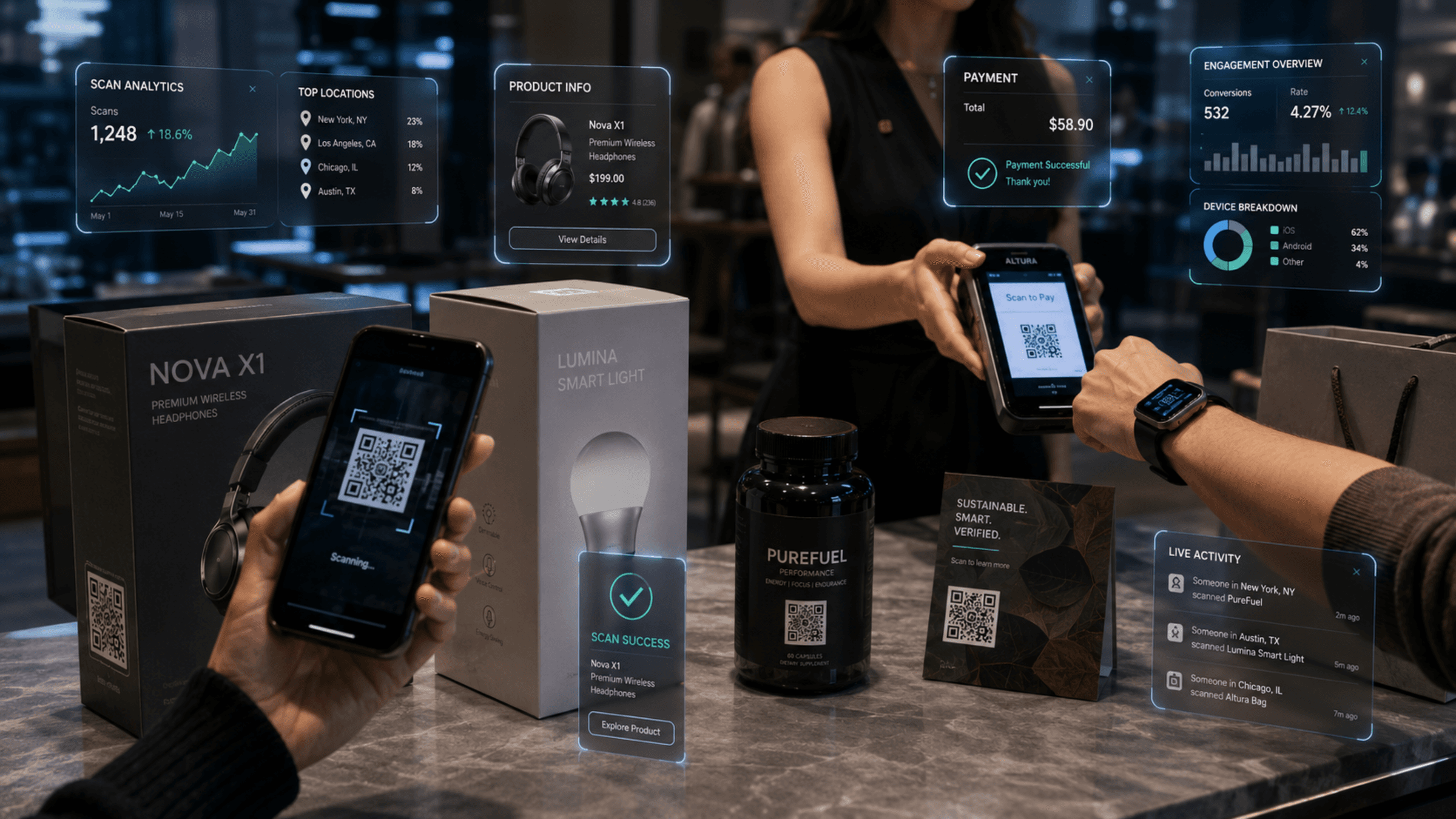
The question is what comes next. Most "future of QR codes" articles published right now make predictions that won't survive 18 months - the technology will replace something else, AI will transform everything, the codes themselves will look completely different.
This piece is the honest version. The trends that are genuinely happening, the predictions worth taking seriously, the ones to ignore, and what this means for businesses planning marketing and infrastructure now.
The 30-second version
Genuinely coming:
- Regulatory mandates expanding. Packaging, food, medical devices, and pharmaceutical sectors increasingly require QR-coded digital information.
- Anti-counterfeit and traceability becoming standard. Unique-per-unit codes are spreading from premium goods to mass-market consumer products.
- AI-personalised destinations becoming common. Not artistic QR codes (that's hype). Personalised landing pages behind otherwise-standard QR codes.
- Payment integration in selected markets. UK and US lagging behind Asia and parts of Europe, but converging.
- Custom domains becoming the professional default. Generic provider domains becoming a credibility tell.
- The free-tier landscape consolidating. A few providers will offer genuinely-free dynamic codes; others will continue free-trial models that disable codes on cancellation.
Probably not coming:
- QR codes being "replaced" by NFC, AR, or anything else. Each has its niche; QR is staying.
- Mass adoption of artistic AI-generated QR codes for general business. Scan reliability issues will keep these in premium-brand niches.
- A unified global QR-payment standard. Regional fragmentation is likely to persist.
- QR codes being banned by Google or Apple. Both platforms have invested heavily in support; reversing course would be costly.
Where QR codes are genuinely winning
The categories where QR adoption is still growing and likely to keep growing:
Regulated packaging.
EU Packaging and Packaging Waste Regulation (PPWR), FDA UDI for medical devices, FSMA 204 for food traceability, pharmaceutical serialisation across most major markets. The direction is consistently toward digital information on physical packaging, and QR codes are the implementation method of choice.
This is where the biggest unforced expansion is happening. The companies that haven't planned for QR codes on their packaging will be doing so within 3-5 years, driven by regulation rather than choice. Implementation budgets are increasing accordingly.
Anti-counterfeit and traceability for consumer goods.
Premium spirits, cosmetics, pharmaceuticals, and luxury goods have used unique-per-unit codes for years. The trend is expanding to mid-market consumer products - supplements, electronics, even food and beverage commodities - driven by counterfeiting concerns and consumer demand for provenance information.
The cost of variable-data printing has dropped significantly, making this economically viable for a wider range of products. Expect to see unique QR codes on increasingly ordinary items over the next five years.
Restaurant and hospitality menus.
Post-COVID, the "QR menu" stayed. The reasons are economic (paper reprints are expensive, digital menus update for free) rather than health-driven, and they don't reverse.
What's changing inside this trend is sophistication: from simple PDF menu QRs to dynamic menus with item-level analytics, allergen filtering, real-time stock indication, and ordering integration. Restaurants that haven't gone beyond a basic QR menu by 2027 will look behind.
B2B sales and networking.
LinkedIn QR codes on business cards are becoming standard at conferences and in B2B sales contexts. The use case - connect with a specific professional after meeting - is genuinely well-served by QR.
Expanding from there: per-prospect dynamic codes on sales collateral, AI-personalised landing pages reached via QR after a meeting, integration with CRM systems. The infrastructure layer is maturing.
Real estate.
For Sale signs with QR codes are becoming standard in most major markets. Open house brochures with QR codes are nearly universal. Vehicle wraps with QR-coded contact and listings are common.
The expansion is into per-property analytics and dynamic destinations that update as listings progress through the sales cycle. By 2027-2028, real estate agencies without dynamic QR programmes will be the exception.
Where QR codes are losing or not gaining ground
Honest about where the predictions haven't panned out and probably won't:
Mass-market billboard and out-of-home advertising.
QR codes on highway billboards still don't get scanned. People driving past don't have time to stop, focus, and scan. The placement is fundamentally hostile to the action. This hasn't changed and isn't going to change.
What works in out-of-home: pedestrian-adjacent placements (bus stops, transit platforms, waiting areas) where people are stationary. Billboards on highways will continue to be a poor fit for QR-driven marketing.
Direct-response TV advertising.
QR codes on TV ads have been pushed repeatedly. The conversion remains low. The reasons are structural: viewers are watching content, not at a moment of decision; their phones are often not at hand; the code is on screen briefly. Even with prolonged on-screen time and high-frame placement, the action friction is too high for most viewers.
Use cases where TV QR codes work: live sports (viewers have phones out), shopping channels (already in buy-mode), and select streaming-service ads where the platform supports companion scanning. General TV advertising QR continues to underperform.
Casual social-follow QR codes.
The trend of putting "Follow us on Instagram" QR codes on every surface peaked around 2022 and is receding. Existing customers don't need help finding accounts they already follow; strangers don't follow random businesses because of a sticker.
What replaces this: more targeted CTAs (reviews, loyalty signups, specific offers) and multi-link landing pages where users can choose what to do.
Generic "scan for more info" codes.
These have always underperformed and the data is becoming impossible to ignore. CTAs need to be specific, benefit-led, and time-signalled. The generic "scan here" approach is fading as marketers learn (or copy) better patterns.
Genuinely coming: AI integration done sensibly
The AI hype around QR codes is mostly noise. The genuine integrations that are happening:
Personalised destinations.
A dynamic QR code links to a server, the server uses AI to generate a page tailored to the visitor's context (time, location, language, device). This is happening now and will become standard for any business with the technical capacity to implement it. By 2028-2030, most consumer-facing dynamic QRs will route through some level of personalisation.
AI summarisation of long-form content.
QR codes that link to long documents (PDFs, manuals, reports) increasingly land on AI-summarised versions with the option to expand into the full document. This pattern is straightforwardly useful and will become common.
Conversational landing pages.
QR codes that open chatbot interfaces. Already common in real estate, expanding to product support, hospitality, and complex consumer products. The bot quality matters enormously - bad chatbots are worse than no chatbots. Expect significant variation in execution.
Optimisation and A/B testing.
QR campaigns increasingly use AI to optimise destination pages, CTAs, and routing rules based on scan data. This is back-end work that users don't see, but it's already changing what works in QR marketing.
What's not coming sensibly:
Artistic AI-generated QR codes for mass use.
These look impressive in marketing materials and fail repeatedly in real-world scanning. Premium brands will continue using them where aesthetics justify the scan-reliability trade-off. Mass-market business will continue using standard QR codes.
AI predicting QR campaign performance.
Marketing analytics tools claim AI-powered performance prediction. The actual value is closer to "summarising data you already have." Don't expect AI to tell you which placements will work before you've tested them.
Payment integration
This is the most uneven area globally.
In China, India, parts of Southeast Asia, and increasingly Brazil: QR payment is mainstream consumer behaviour. WeChat Pay, Alipay, PayTM, PIX, and similar systems handle a huge volume of transactions via QR scan.
In the UK and US: QR payment is rare for in-person retail. Card-tap and phone-tap (Apple Pay, Google Pay) dominate. The convenience advantage of QR doesn't exist when tap-to-pay is already universally accepted.
In continental Europe: between extremes. Some markets adopting QR payment selectively (parking, public transit, restaurants in some countries), others sticking with card/tap.
The trajectory is uneven. Markets without strong tap-to-pay infrastructure are skipping straight to QR. Markets with established tap-to-pay are unlikely to migrate to QR for normal retail. Some specific use cases - peer-to-peer payments, tipping, market stalls, charitable donations - are growing QR payment in Western markets without displacing card-tap.
Realistic prediction: QR payment will grow steadily in markets where it's already established, expand modestly in markets like the UK and US for niche use cases, and continue not being the primary payment method anywhere with strong existing infrastructure. No global unification expected.
The custom domain trend
A specific, observable trend that's accelerating: business-grade QR codes increasingly use custom domains.
Why this matters:
- Customers see the brand's domain when previewing the URL before tapping, reducing phishing concerns.
- The codes look professional rather than generic-provider-branded.
- The brand isn't locked into a single QR provider - DNS changes can move the code's infrastructure.
Where this is heading:
- By 2028, professional B2B QR codes without custom domains will look amateurish.
- Consumer-facing brand QRs increasingly using subdomains.
- QR providers competing on custom-domain pricing and DNS UX.
For businesses planning long-term QR programmes, custom domains are becoming infrastructure rather than premium feature. Plan accordingly.
The provider landscape
The QR provider market is consolidating but not yet consolidated. The state in 2026:
- A few large enterprise-focused providers (Uniqode, qr-code-generator.com / Bitly).
- A range of mid-market providers competing on features and price (QR Tiger, Flowcode, Scanova, Hovercode).
- A growing set of free-tier-friendly providers (QR Cake, ME-QR, several smaller).
- Continued long tail of small, regional, or single-feature providers.
The trends:
- Acquisition activity continuing. Bitly's acquisition of qr-code-generator.com set a precedent. Expect more consolidation, especially of mid-market providers being absorbed into larger marketing platforms.
- Free-tier divergence. Some providers will offer genuinely-free dynamic codes that survive cancellation. Others will continue with free-trial-only models. The distinction will become more important as customers learn the implications.
- API and integration depth becoming a differentiator. Mid-market providers competing on feature breadth; enterprise providers competing on integration depth and compliance certifications.
For buyers, this means more options but also more landscape to evaluate. The criteria that will matter most over the next five years: code longevity (do they survive cancellation), custom domain support, analytics depth, and integration capability.
Three predictions I'd bet on
If I had to predict three things confidently:
1. QR codes on packaging become near-universal in regulated categories by 2028. EU PPWR, FDA UDI, FSMA 204, and pharmaceutical serialisation drive this. Companies that haven't planned for it will be scrambling.
2. The "genuinely free vs free-trial" distinction becomes the most important provider-evaluation criterion. As more printed codes survive longer in the world, the consequences of choosing a provider that disables codes on cancellation become more visible. Reviews and word-of-mouth will reflect this. Code longevity is the single biggest risk.
3. Per-unit unique codes spread from premium goods to mid-market consumer products. Anti-counterfeit and traceability concerns plus dropping cost of variable-data printing make this economically viable for product categories that wouldn't have considered it 3 years ago.
Three predictions I would not bet on
1. "QR codes will be replaced by NFC." They keep being predicted; it keeps not happening. NFC has real advantages for some use cases (transit, contactless payment in some markets) but the friction of QR is now low enough that it's not the bottleneck.
2. "AR will replace QR for in-store information." AR experiences still require the user to open an app and find what they're looking for. QR's "open camera, point, tap" workflow remains faster for the use case of "get me information about this specific thing."
3. "AI-generated artistic QR codes will become the dominant style." The scan-reliability cost is real and visible enough that mass adoption keeps being just-around-the-corner. Premium niches yes; mass market no.
What this means for businesses planning now
If you're making QR decisions today:
1. Plan for codes to live longer than you think. Packaging codes shipped in 2026 will still be in customers' hands in 2030. Pick providers and infrastructure that support that horizon.
2. Invest in custom domains for any serious QR programme. The professional-credibility difference is already meaningful and will grow.
3. Choose a provider whose codes survive cancellation. Code longevity is the single biggest risk factor in long-term QR programmes. QR Cake is one of the providers built around this - dynamic codes keep resolving even after a subscription ends, which is the bar to look for whoever you pick.
4. Add analytics infrastructure from day one. UTM parameters, destination-page analytics, periodic reviews. The data is the difference between guessing and knowing.
5. Stay flexible. The platform-specific features that look hot today (artistic codes, specific platform integrations) may not be the right bets long-term. Plan to evolve.
6. Don't over-invest in trend-chasing. AI personalisation, conversational landing pages, AR overlays - all real, but not all worth implementing today for every business. Start with what works reliably and add complexity as warranted.
Frequently asked questions
Will QR codes still be used in 10 years? Yes. The infrastructure is now universal (every modern phone supports them), the regulatory adoption is increasing, and there's no competing technology positioned to replace them at the use cases they handle well.
Will Apple or Google remove QR support? Extremely unlikely. Both platforms have invested heavily in scanning UX and are unlikely to reverse. The QR ecosystem is now too large to roll back.
Are QR codes safe long-term? The technology is safe. The risks are real but manageable: phishing via fake codes (mitigated by URL preview habits), provider compromise (mitigated by account security), and dependency on QR provider companies (mitigated by custom domains).
Will AR replace QR codes? Unlikely. AR has a real niche for immersive experiences but the friction is much higher (open an app, find the right experience) than QR's "open camera, point" workflow. They'll coexist.
Will NFC replace QR codes? Also unlikely. NFC works for some use cases (transit, payment in some markets, tap-to-pair) but doesn't fit "give me information about this physical thing I'm looking at" as cleanly as QR does.
Will artistic QR codes become standard? Probably not. Scan-reliability issues will keep them in premium niches. Mass-market commerce will continue to favour standard codes.
Is now a good time to start a QR code programme? Yes. The adoption curve is past the early-experimentation phase; the best practices are now well-established; the infrastructure is mature. Starting now means building on solid ground rather than betting on speculative trends.
Will QR payments take off in the UK and US? In specific niches (peer-to-peer, tipping, charity donations, parking, transit), yes. As the dominant retail payment method, unlikely - tap-to-pay infrastructure is too established.
Will regulations require QR codes on more products? Yes. The regulatory trajectory across packaging, food, medical, and pharmaceutical is consistently toward more digital-information requirements. QR codes are the standard implementation.
What's the safest provider choice for long-term QR programmes? One whose codes survive cancellation, supports custom domains, and has been operating for several years. The specific provider matters less than these three criteria.
Bottom line
QR codes have moved past hype and into infrastructure. The future trends worth planning around are regulatory expansion, anti-counterfeit adoption, sensible AI integration, and the increasing importance of code longevity and custom domains. The trends worth ignoring are predictions of replacement by AR or NFC, mass adoption of artistic codes, and global unification of QR payments.
For most businesses, the right move is to build solid QR infrastructure now - dynamic codes, custom domains, proper analytics, longevity-friendly providers - and evolve from there as the landscape develops.
Build your QR infrastructure on a free dynamic platform
Ready to make your own QR code?
Create a dynamic QR code you can edit after printing. Free to start, no card required, unlimited scans, and your codes never expire.

About the QR Cake team
Written by the QR Cake team - the people building QR Cake, a dynamic QR code platform used for editable print campaigns, Canva QR codes, scan analytics, and long-lived QR redirects that keep working after subscriptions end.
Learn more about QR CakeFrequently asked questions
- Will QR codes still be used in 10 years?
- Yes. The infrastructure is now universal, regulatory adoption is increasing, and no competing technology is positioned to replace them at the use cases they handle well.
- Will AR replace QR codes?
- Unlikely. AR has a real niche for immersive experiences, but the friction is much higher than QR's 'open camera, point' workflow. They'll coexist.
- Will NFC replace QR codes?
- Also unlikely. NFC works for some use cases like transit and payment, but doesn't fit 'give me information about this physical thing' as cleanly as QR.
- Will artistic AI-generated QR codes become standard?
- Probably not. Scan-reliability issues will keep them in premium niches. Mass-market commerce will continue to favour standard codes.
- Will QR payments take off in the UK and US?
- In specific niches (peer-to-peer, tipping, charity donations, parking, transit), yes. As the dominant retail payment method, unlikely - tap-to-pay infrastructure is too established.
- Is now a good time to start a QR code programme?
- Yes. The adoption curve is past early-experimentation; best practices are well-established; the infrastructure is mature. Starting now means building on solid ground.
Related Articles
Keep reading practical QR code guides, examples, and optimization tips.
AI + QR Codes: 10 Campaign Ideas That Actually Work (Honest 2026 Guide)
AI doesn't change what a QR code is. It changes what's behind the code - landing pages, conversations, recommendations - and occasionally what the visual design of the code itself looks like.
QR Code API Guide: Generating and Managing Codes Programmatically (2026)
QR APIs come into their own when you need to scale beyond what a human clicking through a dashboard can handle. This is the developer's overview.
QR Cake vs Bitly QR: Which Is Better for Dynamic QR Campaigns?
Both platforms can generate QR codes. The more useful question is which one fits the work you need to do after the code has been printed and published.