QR Codes for Real Estate: The Complete 2026 Guide for Agents and Brokers
The complete real estate QR code playbook - for sale signs, open house brochures, virtual tours, and tracking which properties get the most interest.
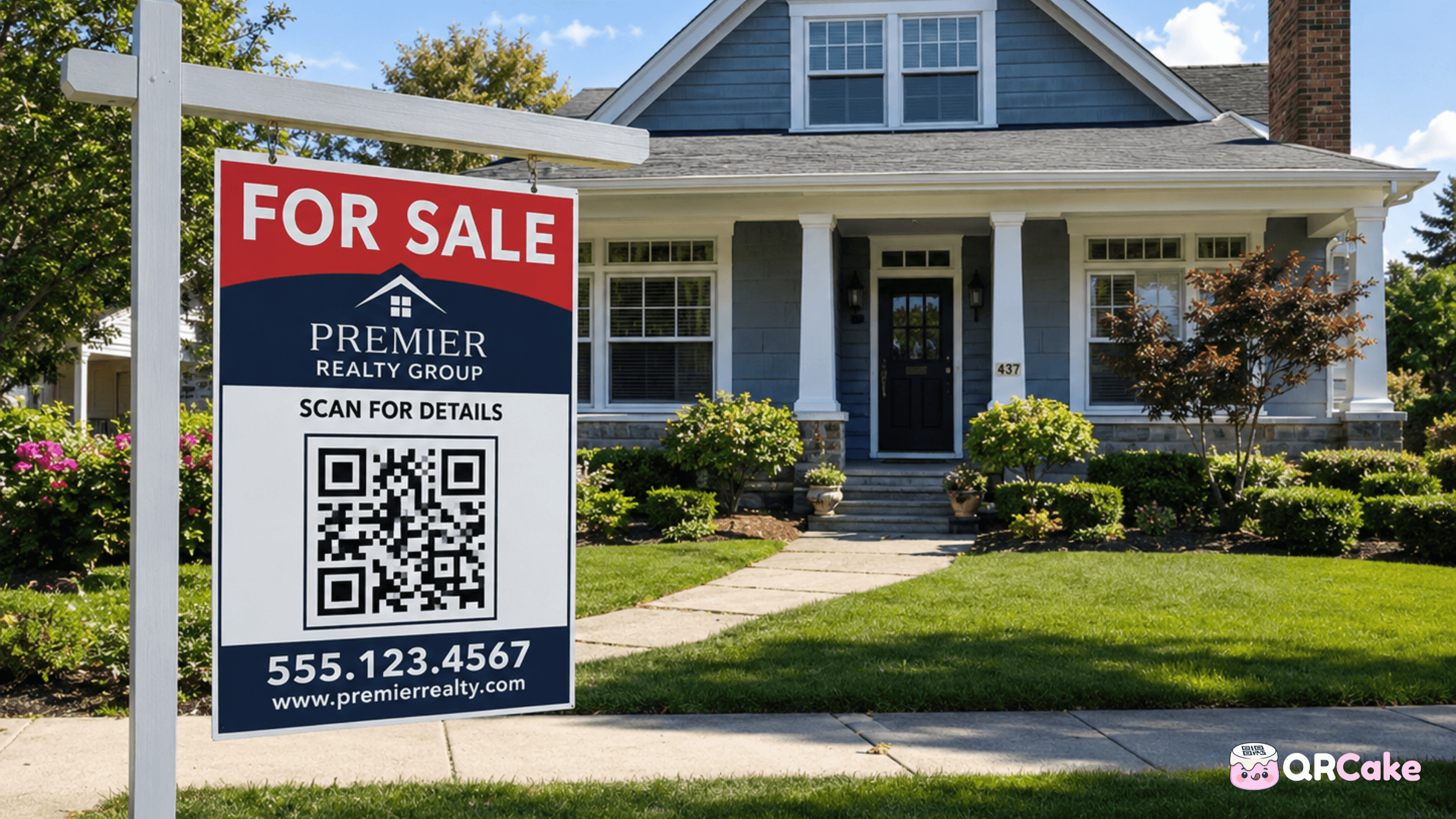
This guide covers every realistic placement (signs, brochures, windows, listing books), what to link each one to, the analytics that actually help an agent close more deals, and the mistakes that waste sign budget.
The 30-second version
For a working real estate QR programme:
- One dynamic QR code per property. Not one shared code for everything - per-property codes give you per-property analytics.
- For sale signs need 10-15 cm codes, not the tiny ones that fit politely in a corner.
- Each property's QR should point at that property's listing page, not your agency homepage.
- Add a clear label: "Scan to see this home's details," "Scan for virtual tour," "Scan for floor plan."
- Track scans by property so you can see which listings drive the most curiosity (even before offers come in).
That's the working version. The rest of this guide explains each piece.
Why every active listing should have a QR code
Real estate marketing has always been about creating moments of buyer curiosity and capturing them. Before QR codes, the only capture mechanism at a For Sale sign was the phone number - and most curious passers-by don't call a phone number. With QR codes, the curiosity-to-information jump takes one second.
Three direct benefits:
- Buyers self-qualify before contacting you. They scan, browse, decide if they're seriously interested, then call. You spend less time on tyre-kicker inquiries.
- You see which listings actually generate interest. Scan counts are a leading indicator - properties with high scan-to-call ratios are the ones to feature more prominently in marketing.
- The buyer reaches your branded property page, not Rightmove or Zillow. They land where you control the narrative and have your contact form ready.
The one caveat: QR codes don't replace traditional real estate marketing. They complement it. A great sign still needs a great sign - and a property with poor photos and a thin listing won't perform better just because there's a code on the sign.
The four core placements
In order of importance to most agents:
1. For Sale signs.
The highest-value real estate QR placement. The buyer is at the property, curious, and idle.
- Size: 10-15 cm minimum. Signs are typically read from 1-2 metres away, and the 10:1 distance-to-size rule means you need a bigger code than people instinctively put.
- Placement on the sign: Eye level for a standing adult - about 1.5 metres from the ground. Most signs are designed with the QR at the bottom, which is suboptimal because viewers have to bend or zoom.
- Label: "Scan to see inside this home." Make the value proposition obvious.
- Destination: The property's dedicated listing page on your site, not the agency homepage.
2. Open house brochures and handouts.
The buyer takes the brochure away. Days or weeks later, they want to remember which property had the great kitchen. The QR code on the brochure brings them back instantly.
- Size: 3-4 cm. Brochures are read at arm's length.
- Placement: Front cover bottom, or back cover top.
- Label: "Scan to revisit the listing" or "Scan for the floor plan."
- Destination: Property listing page with floor plan, virtual tour, and "Book another viewing" CTA prominently visible.
3. Window displays.
For agencies with high-street offices, the window is your biggest advertising surface. Passers-by stop to look. With QR codes, they can scan and see full details without coming inside.
- Size: 8-10 cm per listing card. Big enough to scan from outside through glass.
- Placement: Beside each listing card, at eye level for a standing adult.
- Label: "Scan for full details."
- Destination: The specific property listing page (one per property card).
- Special consideration: Glass reflections are common here. Test scanning from outside in different times of day before committing to layouts.
4. Inside the property during showings.
Strategically placed small standees during open houses. Linked to specific feature information.
- Kitchen: Scan for appliance specifications, included extras, recent renovation details.
- Master bedroom: Scan for floor plan with measurements.
- Garden: Scan for boundary details, planning permission notes, recent improvements.
- Garage/parking: Scan for parking-permit area information.
Most agents skip this and miss a high-engagement opportunity. Visitors at a showing are highly qualified - they're already in the house - and a thoughtful in-property QR programme reinforces the perception of a well-marketed listing.
Less common but valuable placements
Vehicle wraps and signage. Agency-branded vehicles parked near properties can carry a QR code linking to the agency's current listings. Scan rate is low, but for a stationary vehicle near a busy street, it earns occasional inquiries.
Direct mail. Postcards to a target neighbourhood with a QR code to "see properties we've recently sold in your area." Effective for prospecting new listings - homeowners curious about local sale prices scan and self-identify as researching the market.
Magazine and newspaper ads. Local property magazines and free newspapers still drive real estate inquiries in many UK and US markets. A QR code on the printed ad converts the casual browser.
Brochure boxes at the property. If you use external brochure boxes, the boxes themselves can carry a QR code as a fallback when the printed brochures run out. "Out of brochures - scan here for full details."
Letter-drop campaigns. Door-knocked letters to specific properties can include a QR linking to a customised value-estimation page. Useful for sellers' agents prospecting in active neighbourhoods.
Estate agent business cards. Personal cards with a QR pointing to the agent's full portfolio and current listings - covered in our business card QR code guide.
What to link each placement to
The most common real estate QR mistake is linking everything to the agency homepage. The buyer scanning a sign for 18 Oak Lane doesn't care about your full portfolio. They care about 18 Oak Lane.
Linking by placement:
| Placement | Best destination |
|---|---|
| For Sale sign | The property's dedicated listing page |
| Open house brochure | Listing page with virtual tour and floor plan prominent |
| Window display | The specific property's listing page |
| Inside the property | A feature-specific page or video |
| Vehicle wrap | A "Currently available" page with all active listings |
| Direct mail (prospecting) | A neighbourhood-specific page with recent sales data |
| Magazine ad | The specific property featured in the ad |
| Brochure box | The same listing page the brochure pointed at |
The pattern: the more specific the placement, the more specific the destination should be. A code attached to a single property should land on that property's page. A code attached to a brand presence (vehicle, agent card) can land on a broader page.
Analytics that actually matter for real estate
Dynamic QR analytics in real estate go beyond "how many scans." The useful metrics:
Scans per property over time. Properties with steady scan counts have steady curiosity. Properties whose scan counts fall off a cliff after the first week may need price re-evaluation or fresh marketing.
Scans-per-call ratio. Twenty scans and one call suggests the listing is generating curiosity but not converting browsers to inquirers - maybe the photos undersell the property, or the price is wrong. Two scans and two calls suggests highly qualified interest at low volume.
Scans by time of day. Weekend-afternoon scans usually indicate physical drive-by traffic. Weekday-evening scans often indicate buyers researching from home - they spotted the property earlier and are following up.
Scans by location. Local scans suggest local buyers. Scans from further afield (other cities, other countries) suggest relocation buyers - different sales motion, different timeline expectations.
Scans on listing day vs day 30 vs day 60. A property that gets most of its scans in the first week is "new and shiny" - if it hasn't sold, you need new marketing energy.
For agents managing multiple properties, the per-property scan dashboard becomes one of the more useful real-time signals you have about market interest.
How to set up a real estate QR programme
The setup for a working multi-listing programme:
- Pick a dynamic QR code provider that supports unlimited or high-volume free dynamic codes (more properties = more codes; you don't want per-code fees). Choose one whose codes don't break when subscriptions end.
- Set up a custom domain like qr.youragency.com. This makes codes look professional and means you can switch providers later without reprinting signs.
- Generate one code per listing at the moment you list the property. Name each code clearly in the dashboard ("18 Oak Lane sign," "18 Oak Lane brochure," etc.).
- Print and place signs with the code at 10-15 cm.
- Monitor scans weekly. Use the data to inform marketing and pricing conversations with vendors.
- When a property sells, point its code at a sold-page instead of leaving it dead. The sold page can include "Find your next home" CTAs and recently-sold comparable properties.
- At year-end, audit dormant codes for old listings and either redirect them to active marketing pages or archive them.
Common real estate QR code mistakes
Mistake 1: One code for everything. A single agency QR code on every sign and brochure loses all per-property analytics value.
Mistake 2: Code too small for sign distance. Signs are read from 1-2 metres. A 4 cm code at that distance often fails. Print at 10-15 cm.
Mistake 3: Linking everything to the agency homepage. Customer scans a sign for one property, lands on a page about your agency's entire portfolio. Bounce rate is enormous.
Mistake 4: No call-to-action label. A bare QR code on a sign gets fewer scans than one with "Scan to see inside" written next to it.
Mistake 5: Static QR code on a property sign. When the price drops, the listing page URL changes, or the property sells, the static code is stuck pointing at the wrong destination. With a QR Cake dynamic code on the sign, you can swap the destination from "available" to "under offer" to "sold - see similar properties" without reprinting or replacing a single sign.
Mistake 6: Forgetting to update destinations when listings move. Set a calendar reminder when properties go under offer to update the QR destination to "Under Offer - see similar properties."
Mistake 7: QR provider whose codes break on cancellation. If your subscription lapses, every sign in the field stops working overnight. Pick a provider with code longevity, or set up a custom domain so you can switch.
Mistake 8: Not testing the destination on mobile. Listing pages that load fast on desktop but lag on 4G mobile feel broken at the moment of scanning.
Frequently asked questions
Should I use one QR code for my entire agency or one per property? One per property, almost always. Per-property codes give you per-property analytics, let you point at specific listing pages, and let you update each listing's destination independently.
Where should the QR code go on a For Sale sign? Eye level for a standing adult - about 1.5 metres from the ground. Many sign templates put the QR at the bottom, which is suboptimal because viewers have to bend down to scan.
How big should the QR code be on a sign? 10-15 cm. Signs are read from 1-2 metres away, and the 10:1 distance-to-size rule means smaller codes don't reliably scan from that distance.
What if my For Sale sign gets damaged or weathered? QR codes have error correction that tolerates some damage. For real estate, use waterproof inks, laminated overlays, or printed-on-aluminium signs. Replace damaged signs promptly - a broken QR code is worse than no QR code because it signals to buyers that the listing isn't being maintained.
Can I use a QR code on a magazine or newspaper ad? Yes. 3-4 cm size, near the listing photo. Magazine reading happens at arm's length, so a code that size scans reliably.
Should the QR code link to Rightmove/Zillow/Trulia or my own site? Your own site if the listing page there is well-built. Third-party listing sites give visitors more comparison tools (which can lose your buyer to a different agent), so your site keeps the buyer in your funnel.
How do I track which sign got scanned versus which brochure? Generate separate dynamic codes for each placement, even within the same property. The sign code and the brochure code point at the same listing page but track separately, so you can see whether the sign or the brochure is generating more interest.
Can I use QR codes for FSBO (For Sale By Owner) listings? Absolutely - and the analytics are particularly useful for FSBO sellers who don't have an agent's experience to gauge interest. Scan counts give independent sellers a real signal.
What's the best QR code provider for real estate? For most agencies, look for: free dynamic codes (you'll create many over time), per-code analytics, custom domain support, and codes that survive cancellation. QR Cake meets these criteria; the Best QR Code Generators post covers alternatives.
Will buyers scan QR codes on properties? Yes, especially during evenings, weekends, and at open houses. Scan-through rates on well-placed real estate QR codes routinely outperform direct phone-call rates from the same sign.
Bottom line
Real estate is one of the strongest fits for QR codes. The buyer is curious, stationary, and ready. Get the size right, point each code at a specific destination, and track per-property to see what's really generating interest.
Generate a free dynamic QR code for your next listing
When a real-estate QR code is not the right call
QR codes earn their place in most real-estate marketing, but five scenarios where they underperform other channels:
- Off-market or pocket listings. If there is no public listing page, the QR has nothing useful to point at. Direct conversation works better.
- Properties in extremely rural areas with no mobile signal. A buyer at the sign cannot scan if their phone cannot load the page. Check signal at the sign location before relying on a QR.
- Ultra high-end listings. Buyers at the top of the market typically work through agents and rarely scan signs themselves. The QR is not wasted, but the marketing budget yields more elsewhere.
- Estate or short-window listings. If the listing is up for 10 days and the sign comes down, a static QR pointing at that listing will become a dead link. Use a dynamic code so the destination can be reclaimed.
- Listings where you do not own the destination page. Pointing a QR at a portal listing (Zillow, Rightmove, Realestate.com.au) sends the buyer somewhere you cannot edit, with their competitor listings one click away. Always link to a page you control.
The pattern: QR codes work when the buyer has time, signal, and a useful destination. When any of those three is missing, choose another channel.
Ready to make your own QR code?
Create a dynamic QR code you can edit after printing. Free to start, no card required, unlimited scans, and your codes never expire.

About the QR Cake team
Written by the QR Cake team - the people building QR Cake, a dynamic QR code platform used for editable print campaigns, Canva QR codes, scan analytics, and long-lived QR redirects that keep working after subscriptions end.
Learn more about QR CakeFrequently asked questions
- Should I use one QR code for my entire agency or one per property?
- One per property, almost always. Per-property codes give you per-property analytics, let you point at specific listing pages, and let you update each listing's destination independently.
- Where should the QR code go on a For Sale sign?
- Eye level for a standing adult - about 1.5 metres from the ground. Many sign templates put the QR at the bottom, which is suboptimal because viewers have to bend down to scan.
- How big should the QR code be on a sign?
- 10-15 cm. Signs are read from 1-2 metres away, and the 10:1 distance-to-size rule means smaller codes don't reliably scan from that distance.
- Should the QR code link to my own site or a portal like Rightmove?
- Your own site if the listing page is well-built. Third-party portals give visitors comparison tools that can lose your buyer to a different agent; your site keeps the buyer in your funnel.
- Will buyers actually scan QR codes on properties?
- Yes, especially during evenings, weekends, and at open houses. Scan-through rates on well-placed real estate QR codes routinely outperform direct phone-call rates from the same sign.
- How do I track which sign got scanned versus which brochure?
- Generate separate dynamic codes for each placement within the same property. Both point at the same listing page but track separately, showing which is generating more interest.
Related Articles
Keep reading practical QR code guides, examples, and optimization tips.
QR Codes on Product Packaging: The 2026 Guide (Use Cases, Regulations, and Pitfalls)
Most major CPG brands now ship products with QR codes. The interesting question is no longer whether to use a code, but what for - and most teams underperform here.
How to Create a Google Review QR Code (Step-by-Step, 2026)
Google reviews drive local search rankings, trust, and conversion. A QR code that takes customers directly to your review form removes the single biggest barrier to actually leaving one.
Business Card QR Code Guide: Size, Placement, and What to Link To (2026)
A QR code on a business card is the single highest-ROI use of QR on print. The card lasts as long as the design; the destination updates with your career.